
For years, security and risk leaders handled incident response by piecing together people, tools and processes as each incident demanded, and it cost them: confused ownership, conflicting updates and a timeline nobody could reconstruct once the incident was over. In January 2026, Gartner gave the solution a name: Cybersecurity Incident Response Management, or CIRM.
Detection and remediation tools still do their job, catching and containing a threat. CIRM covers what happens after that, the moment an incident stops being IT’s problem alone. It’s a category built to address the challenges that come with getting legal, executives, outside counsel, insurers and the rest of the business into one response, including safely communicating out-of-band, mitigating damages, controlling access to information and filing regulatory reports in a timely manner.
What’s driving the Cybersecurity Incident Response Management category?
Three forces converged to push cybersecurity incident response into a category of its own.
For one, regulators stopped treating disclosure as optional. NIS2, written into national law across the EU in October 2024, covers 18 critical sectors, sets a 24-hour notification window, and backs it with fines of up to 2% of global turnover. And in the US, the SEC has required public companies to report a material cybersecurity incident within four business days of determining its material since December 2023. CISA’s pending CIRCIA rule is expected to add 24-hour reporting requirements for ransomware payments made by covered critical infrastructure entities.
The pressure isn’t only coming from regulators. Boards increasingly want to know if the organization is ready for a critical incident, that leadership can control a response and that every decision will hold up to scrutiny afterwards. That’s a serious shift. Ten years ago, a CISO was judged on whether a breach happened. Today, they’re judged — and in some cases held personally liable — on how they prepared for and handled the response.
Layer those personal and regulatory stakes on top of how a major incident unfolds. Legal, executives, outside counsel, insurers and forensics teams all need to be pulled in, often within hours, and every one of them needs visibility a security tool was never built to give them. No patch fixes that. The organization itself needs a system built for the job, and until recently, there wasn’t one.
What’s wrong with relying on existing tools for incident response?
Most security teams already have solid stacks for the technical side of incident response: a SIEM to detect, a SOAR platform to automate, an ITSM system to ticket. That tooling isn’t going anywhere, and it shouldn’t. Each one is built for a specific purpose.
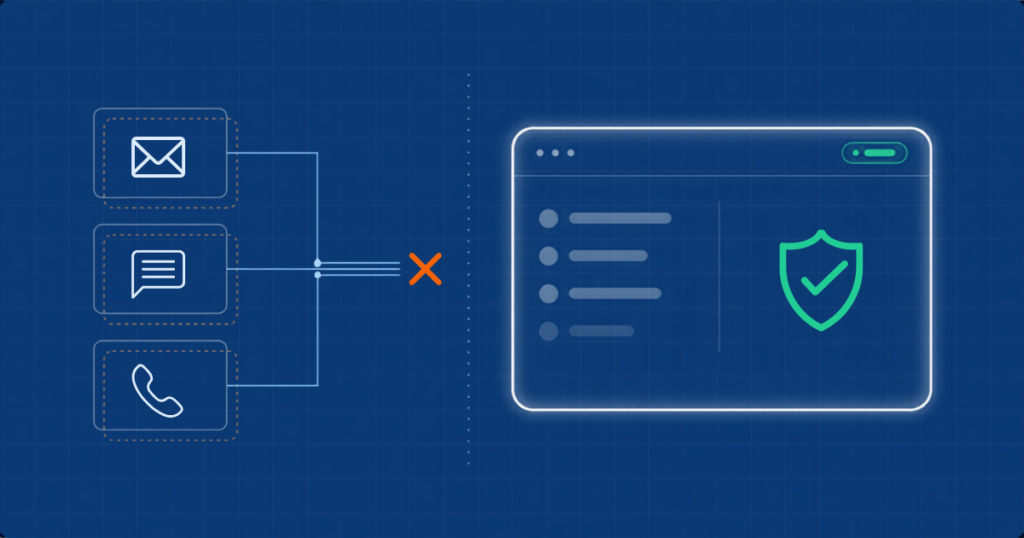
The challenge shows up the moment an incident stops being a security-team problem and becomes a business one. It comes down to one idea: an out-of-band platform. Most response tools run in-band, meaning they sit on the same identity systems, email and network infrastructure that may already be compromised during an incident. When the network goes down, the tools you were counting on can go down with it. Or when a cyber incident happens via social engineering, day-to-day communication platforms like Slack and email can’t be trusted. An out-of-band platform runs apart from all of that, so your team can keep working on the response, out of the attacker’s sight.
Separate from the infrastructure, technical tools weren’t built to include people who aren’t security engineers. An executive doesn’t have a SIEM login. Outside counsel doesn’t get a ticketing seat. The moment legal, the board or an insurer needs to be looped in, teams learn a hard lesson. More communication doesn’t always mean more control.
There’s a higher-stakes reason in-band tools fail. Everything said in Slack, Teams or email during an incident is potentially discoverable, and using them can strip away the legal privilege a company is counting on. Take the litigation over Capital One’s 2019 breach. A federal court ordered the company to hand over its own forensic investigation report, after finding it was prepared for ordinary business purposes rather than solely for litigation. That finding cost Capital One its work-product protection. The infrastructure problem and the privilege problem compound each other. The tools most teams reach for in a crisis are the same tools most likely to undermine the legal protection they’ll need afterward.
What does a real CIRM platform add?
Gartner’s definition sets concrete criteria for what counts as Cybersecurity Incident Response Management. Two distinctions matter most:
A CIRM platform gives responders their own case-management and workflow layer, purpose-built for running a live incident rather than a SOAR tool or ticketing system stretched to cover a job it was never designed for. A CIRM solution tracks who’s doing what, what’s been decided, what still needs sign-off, and what the record looks like once the incident is over.
A Cybersecurity Incident Response Management platform is expected to work when your core systems don’t. If single sign-on is down or email is compromised, the platform running your response can’t depend on either one staying up. That’s the out-of-band expectation Gartner’s research calls out directly in the CIRM category, and it’s becoming a baseline requirement for incident response.
How should a CISO’s team evaluate a CIRM platform?
Five questions do most of the work.
- Can you rehearse your cyber incident response plan in the environment you’ll respond in? Look for a platform that lets you build incident response playbooks in advance, either pulling from a prebuilt library or importing your own, then rehearse in that same environment to build muscle memory across the organization. The platform should generate an after-action report within minutes to help you capture what breaks during rehearsal and feed improvements back into the plan.
- Can you bring in outside counsel, forensics and your cyber insurer with role-based access control? Look for granular, role-based permission that let each outside party see only what is needed. That’s what helps keep privilege intact and means you control who sees what and when.
- Can you verify identity out-of-band when your identity provider is down or compromised? A real out-of-band environment does more than give you a backup channel to talk on. Look for one that verifies identity on its own, so people can prove who they are and get into the response room even when SSO and/or email are compromised.
- Can you adjust your cyber incident response plan as new facts, new jurisdictions or new stakeholders enter the picture? Real incidents rarely unfold exactly as planned. Facts change, new jurisdictions enter the picture and people named in the plan move on. Look for playbooks that adapt as the situation changes, pulling in the right steps and people, instead of a static document somebody has to revise in the middle of an active response.
- Can you keep an audit trail that holds up for regulators? Look for system of record that logs every action, communication and decisions with a timestamp as it happens, then automatically populates the reports regulators expect instead of leaving someone to reconstruct them from memory and fragmented channels. The strongest CIRM platforms preserve that record and its chain of custody for years, well after the incident itself is closed.
The bottom line on cyber incident response management
Gartner’s research validates what security and risk leaders already knew. The moment a major incident escalates past IT and security, it stops being a security problem and becomes a business one, and business-critical cyber incidents need their own category of tooling. CIRM doesn’t replace your existing security stack, and adopting it isn’t an admission that those tools failed you.
If your organization is still handling enterprise-wide incident response with in-band tools — email, chat, a shared drive — you’re familiar with the chaos and misalignment that can comes from it. Nobody’s sure who owns what, legal is chasing a thread that keeps moving, and executives and the board end up working from two different versions of the same day. When it’s over, nobody can reconstruct the timeline, and the privilege you were counting on evaporates the moment a court tests it. CIRM platforms exist to solve these challenges, giving organizations one out-of-band platform to manage the incident response lifecycle for major cyber incidents.
Over 3,000 organizations rely on CYGNVS for out-of-band cyber incident response management, with the platform handling more than 50 major incidents a week across industries and jurisdictions. If your team is ready to see what a purpose-built CIRM platform looks like in practice, we’re happy to walk you through it.
Talk to our team about evaluating a CIRM platform.
Common Questions About CIRM
What does CIRM stand for?
CIRM stands for Cybersecurity Incident Response Management. Gartner introduced it in January 2026 as a category for platforms that manage a major incident from preparation through regulatory reporting.
Is CIRM the same as SOAR or SIEM?
No. SIEM detects threats and SOAR automates technical response. CIRM gives the whole organization — not just security — its own case-management and workflow layer for running a live incident, including people who’d never have a SOAR login: executives, legal, outside counsel and insurers.
Does CIRM replace our existing security stack?
No. CIRM works alongside detection and remediation tools. It adds the case management, communication and reporting layer those tools were never built to provide.
What does “out-of-band” mean in incident response?
An out-of-band platform runs apart from an organization’s everyday identity systems, email and network infrastructure, so a response team can keep working even if those core systems are down or compromised. Gartner’s research names out-of-band deployment as one of the two defining capabilities of the CIRM category, alongside a dedicate case-management system of record.
Is CIRM only for large enterprises?
Any organization managing regulatory disclosure deadlines, board oversight or multi-party coordination during a major cyber incident benefits from a CIRM platform. Incident volume keeps rising across organizations of every size, and ad hoc response breaks down fastest under pressure.