
Secure Out-of-Band Communication for Incident Response
CYGNVS keeps your response running in one secure place, out of reach of the attacker, even when email, chat and single sign-on are compromised. Patented out-of-band architecture, with Isolate Mode and Dynamic Tenancy.
A serious breach rarely stays in IT for long. Legal, executives, outside counsel and insurers quickly need to make decisions together, often in the very tools the attacker is inside. Out-of-band communication means running that response somewhere else: on a separate platform, with separate identities, that keeps working when your own network can’t be trusted. More than 3,000 organizations in 71 countries rely on CYGNVS, and 50+ major incidents run on the platform every week.
Attackers Go After Communications First: What Out-of-Band Means
In incident response, secure out-of-band communication has a practical meaning: the people running the response can talk, share files, make decisions and record them without touching the email, chat, conferencing or identity systems that may be compromised.
That separation has to be real. A backup video link that still signs in through corporate SSO is not out-of-band. Neither is a group text on personal phones. It is separate, but nobody controls who is in it, nothing is logged, and nothing survives as a record you can defend later.
Government guidance treats this as basic practice. In its joint advisory on incident response, CISA lists “Communicating over the same network as the incident response is being conducted” as a common mistake, with the instruction to “ensure all communications are held out-of-band.” A 2025 CISA advisory goes further: the incident response plan “should include procedures for establishing out-of-band communications systems and accounts in case primary systems are compromised or not available (such as with ransomware incidents).”
In operational terms, out-of-band means four things are true at the same time:
- Separate infrastructure. The platform runs outside your network, so taking systems offline to contain an attack doesn’t take the response down with them.
- Separate identity. Responders sign in with credentials that don’t depend on your directory or SSO.
- Controlled access. Each participant sees what their role requires and nothing more.
- A durable record. Every message, file and decision is logged in one place you can hand to regulators, auditors and courts later.
What Breaks When the Response Runs Inside Your Network
Corporate SSO, email and infrastructure are the systems most often compromised. When an attacker holds administrator access, the tools your team reaches for first are the ones most exposed.
Email turns into a listening post. Jacqueline McCullough, writing on cygnvs.com in 2024, describes the scale from her time on the incident response vendor side: “it’s normal to receive more than 1,000 emails from various stakeholders related to any one cyber incident.” In one case, “the threat actor reached out to me and other stakeholders directly on our personal emails.” The attacker had been reading the client’s mail, and resolving the incident took much longer because a separate email platform had to be stood up mid-response. (Read her account.)
Identity stops being trustworthy. If the directory is compromised, so is every login built on top of it. Credentials may be revoked or monitored, and resetting accounts to lock the attacker out can lock your own responders out at the same moment.
Chat and conferencing share the same weak point. They usually sit behind the same sign-in as email, so moving the conversation to chat moves it from one compromised system to another.
People scatter to personal channels. Decisions drift into personal phones and private threads, with no access control, no audit trail and a real risk to legal privilege.
Compromised Logins? Isolate Mode Switches to Verified Backup Identities
Out-of-band communication only works if you can trust who is on the other end. CYGNVS builds identity into the out-of-band design. It maintains a separate corporate identity for every user, accessible even when SSO is down and email is compromised.
Here is how the switch works:
- Backup identities are verified up front. When each person registers, CYGNVS captures and verifies backup forms of identity, long before any incident.
- CYGNVS stays connected day to day. Before an incident, it integrates with your corporate systems, including your SOC tools and SSO, and with ticketing, SIEM and SOAR through pre-built connectors, webhooks and an open API. Incident rooms can be triggered from the tools your team already uses.
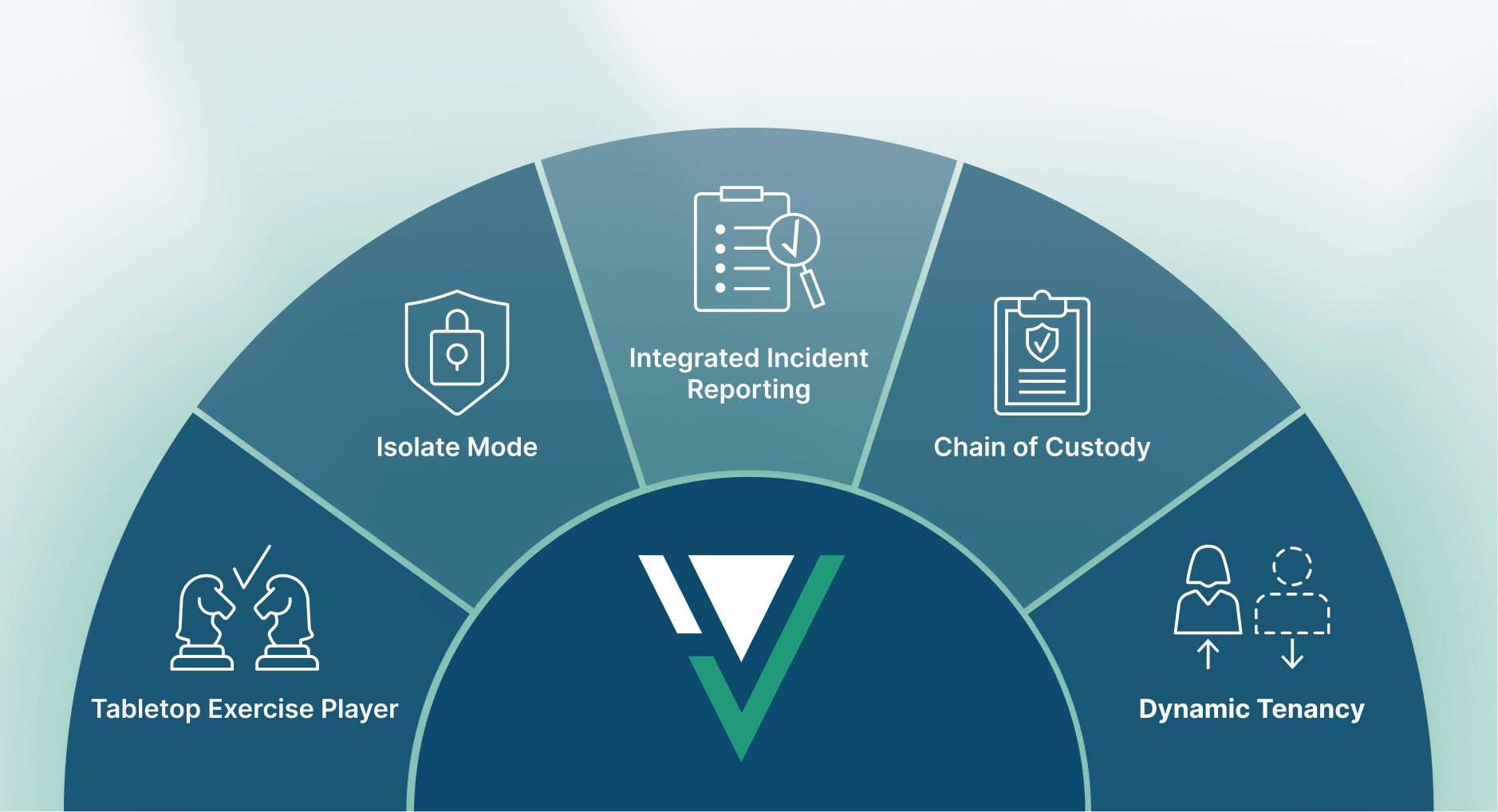
- Isolate Mode cuts the cord. When a severe incident is declared, you turn on patented Isolate Mode. In the words of the CYGNVS integrations page, it “instantly severs every integration, cuts off corporate communication channels and switches to backup authentication.” Your response team stays fully operational on verified backup identities.
- Results come back afterwards. Once the crisis is over, CYGNVS re-integrates and brings the results back into your corporate systems, so the record isn’t stranded.
You choose how isolated to be. CYGNVS supports five postures: always integrated; isolated only during a crisis; scheduled integration windows; integrated at setup and then isolated; or always isolated, with data imported and exported manually.
Protecting Privilege and Chain of Custody Under Pressure
During a breach, what people write and where they write it can become evidence in lawsuits and regulatory investigations. Privilege protections are narrower than many teams assume. The Wilson Sonsini white paper on asserting and preserving privilege, published on cygnvs.com, makes three points every response team should know:
- “Attorney-client privilege protects only legal advice communications, not underlying facts, and may be waived if shared broadly.”
- Case law, including In re Capital One, shows “courts compelling production of forensic reports when they could have been prepared for business purposes, not solely for litigation.”
- Recommended practices include “engaging outside counsel early, retaining third parties through counsel, using secure platforms with granular access controls, and avoiding unnecessary distribution of sensitive documents.”
An out-of-band platform does not decide what is privileged. Counsel does. The platform makes counsel’s instructions enforceable: legal runs its own workstream, outside firms are engaged through counsel, and access is granted by role, so sensitive analysis isn’t forwarded to people who don’t need it.
Chain of custody works the same way. Every action, communication and decision is logged with timestamps, giving you one system of record for regulators, courts and auditors, years after the incident. CISA’s 2025 guidance makes the same point about evidence, advising organizations to “aggregate logs in a centralized out-of-band location.”
The record also feeds disclosure. US public companies must disclose material incidents to the SEC within four business days of determining materiality. CYGNVS carries regulatory templates for 153 jurisdictions, filled from the incident record rather than rebuilt from scattered email.
For the step-by-step legal view, see Protecting Privilege in Practice During Cyber Incidents.
Who Belongs in the Out-of-Band Room, and Who Doesn’t
In practice, anywhere from 10 to 30 people are typically involved in communication around a major incident. They don’t all need the same view. A good out-of-band room is built around roles:
- Security and IT run the technical investigation and containment.
- General counsel and outside breach counsel direct privileged work and decide what gets written where.
- Executives make the business decisions: shutdowns, customer impact, disclosure.
- The board is brought in at thresholds you have agreed in advance, with the decisions it owns spelled out.
- Communications and HR need verified facts before they say anything to customers, the press or staff, but not the technical telemetry.
- Insurers and brokers need early notice and a clear view of the claim.
- Outside specialists, such as forensics firms, negotiators and PR agencies, need access to their own workstream and nothing beyond it.
Outside firms bring their own people and can change mid-incident. CYGNVS handles that with Dynamic Tenancy. You can invite external providers into an incident room and let each provider manage its own employees, with fine-grained access across every external user. If you change providers mid-incident, the new firm picks up where the old one left off. You also set data retention policies for each external provider.
Six Steps to Get Out-of-Band Ready Before an Incident
The middle of an incident is the worst time to find out who can’t log in. Six steps to take now:
- Register your people and verify their backup identities. This is the step that makes Isolate Mode work later.
- Load your playbooks. Import the plans you already have, or start from a library of more than 45 prebuilt plans and playbooks, and assign owners across security, IT, legal, communications, HR and leadership.
- Onboard outside providers in advance. Outside counsel, forensics firms and PR agencies can be onboarded before an incident, so mobilizing them takes minutes rather than hours.
- Decide your isolation trigger. Agree who can declare a severe incident, at what threshold, and which integration posture you’ll run day to day.
- Write the board playbook. Define when the board is told and which decisions it owns, then rehearse it with directors.
- Practice where you’ll respond. Run tabletop exercises inside the same out-of-band platform, using real playbooks, real roles and a library of 60+ scenarios. After-action reports are generated in under five minutes, so gaps get fixed while they are fresh.
CYGNVS gets organizations response-ready within 7 days of signing. For the full Prepare, Practice, Respond and Report cycle, see the incident response lifecycle.
Out-of-Band Response Proven on Live Incidents Every Week
An out-of-band platform has one job: to be there, and trusted, when nothing else is.
- 3,000+ organizations in 71 countries rely on CYGNVS.
- 50+ major incidents run on the platform every week.
- CYGNVS AI is trained on 25,000+ real-world major incidents.
- 153 jurisdictions covered by built-in regulatory templates.
- Response-ready within 7 days of signing.
- CISO liability insurance is included with the subscription, underwritten by AIG. See how the coverage works.
How Out-of-Band Deployment Fits the CIRM Category
Gartner identifies eight core capabilities for Cybersecurity Incident Response Management (CIRM) solutions, and CYGNVS delivers all of them. Out-of-band deployment is one of the eight, alongside a system of record, response playbooks, automation, integrations, least privilege enforcement, communications and collaboration, and reporting and analysis. If you are evaluating platforms against the category, start with what CIRM covers and why CIRM starts with out-of-band.
How CYGNVS Compares
How Does CYGNVS Compare to Other Incident Response Tools?
Most incident response tools are built for the security team working inside the corporate network: ticketing systems, SIEM and SOAR platforms, and general chat and video apps. CYGNVS is built for the moment an incident escalates to the business, when legal, executives, outside counsel, insurers and regulators get involved and corporate email or chat may be compromised. It runs out-of-band, separate from your network, email and single sign-on, so the response keeps running when those systems are down. It is also the only incident response platform that includes CISO liability insurance in the subscription and uses AI trained on 25,000+ real-world major incidents.
Questions Buyers Ask About Out-of-Band Communication
Isn’t a Backup Chat App or a Personal Phone Good Enough?
Not for a major incident. Personal phones and consumer apps are separate from your network, but nobody controls who is in the conversation, nothing is logged, and sensitive legal discussions end up outside counsel’s control. A backup tool that still signs in through corporate SSO isn’t separate at all.
How Does CYGNVS Keep Working If Our SSO Is Compromised?
Every user has backup forms of identity that are captured and verified when they register. When you turn on Isolate Mode, CYGNVS severs its integrations, cuts off corporate communication channels and switches users to backup authentication, so responders can keep working even when SSO is down and email is compromised.
Does an Out-of-Band Platform Protect Attorney-Client Privilege?
A platform can’t create privilege; counsel does. What it can do is support the practices that preserve privilege: engaging outside counsel early, keeping sensitive work in access-controlled workstreams, limiting distribution and keeping an auditable record. CYGNVS is built around role-based access, Dynamic Tenancy for outside firms and a complete audit trail.
See CYGNVS Out-of-Band in 30 Minutes
Walk through how your team would run a major incident when email, chat and SSO can't be trusted.