
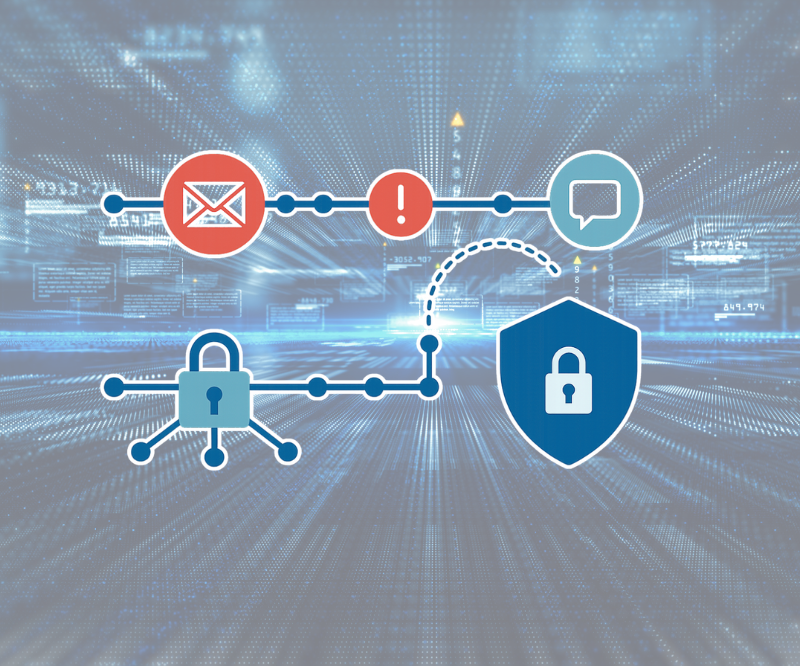
You already harden endpoints, watch identity, and scan cloud services. During a real incident, none of that matters if the attacker sits inside your email, chat, or SSO. You need a clean line to coordinate. That is the core value of out-of-band communications.
This piece explains what “out-of-band” means, why major frameworks expect it, and how to implement it so you protect privilege, move faster, and meet disclosure requirements.
What “out-of-band” means in practice
Out-of-band communications live on a separate channel from your production systems. If adversaries have access to corporate email, chat, conferencing, or your identity provider, you switch to an independent command center and keep working.
Security leaders have seen attackers go after comms first. Once inside, they read email, watch chats, and anticipate moves. That turns response into chaos. As Arvind Parthasarathi, CEO of CYGNVS, put it, threat actors “go straight for your communication channels… email, Active Directory, SSO, conferencing systems,” because that is where you respond. Out-of-band gives you a “hurricane bunker” where you can gather the right people, run playbooks, and protect privilege.
Why it matters now
1) Guidance and rules expect it
NIST’s updated incident response profile (SP 800-61r3) ties response to CSF 2.0 and emphasizes prepared, tested plans that work when systems fail. (NIST) CISA warns against “communicating over the same network” during response and calls for out-of-band communications and centralized out-of-band logging. (CISA) CISA also advises encrypted apps over regular calls and SMS for sensitive roles. (Reuters)
2) AI is supercharging intrusion speed and deception
CrowdStrike’s 2025 report documents more malware-free intrusions, valid account abuse, and cross-domain attacks that slip past controls. Once adversaries have trusted access, you have minutes to adapt. (CrowdStrike) Arvind’s take tracks with that reality: generative tools fix phishing tells and scale targeting across your org. During a live incident, “no one wants a chatbot,” you want help sifting options while humans make fiduciary decisions.
3) Costs are still high and scrutiny is rising
IBM’s 2025 report still pegs average global breach costs in the multi-million range, with AI-related security gaps adding pain. (IBM) Public companies must disclose material incidents within four business days after determining materiality. Your communications and documentation need to be fast, accurate, and defensible. (SEC)
What good looks like
Build a company-owned, access-controlled command center
Do not rely on personal accounts or ad hoc consumer apps. Use a company-owned system to avoid insider risk, turnover issues, and privilege leaks. Your command center should enforce role-based access, separate workstreams for legal, PR, IT, and vendors, and keep audit trails for regulators and customers. For a reference architecture, see CYGNVS’ overview of the incident response lifecycle, including prepare, practice, respond, and report.
Prepare your “board playbook”
Define when the board is told, what thresholds trigger involvement, and which decisions they own. Then practice with directors so they understand their role. NIST’s 2025 update encourages this kind of programmatic alignment across the business. (NIST Computer Security Resource Center)
Train where you will fight
Tabletop in the same out-of-band system you will use in anger. Frequent tabletops build muscle memory and expose gaps before an attack. Many organizations now run dozens of exercises each year across legal, forensics, critical vendors, and business units. CYGNVS explains this approach in Preparation and Practice.
Protect privilege by design
During a breach, what people see and where they say it matters. Courts have narrowed privilege when communications look like routine business rather than legal advice. Use counsel-led engagement, restrict distribution, and keep sensitive work in a secure, out-of-band workspace that logs access. See CYGNVS resources on protecting privilege in practice and the Wilson Sonsini whitepaper on asserting and preserving privilege.
Centralize out-of-band evidence and reporting
Keep clean copies of critical logs and incident artifacts outside the compromised network. CISA’s latest advisory explicitly calls for “centralized out-of-band” logging and for IR plans that include procedures to establish out-of-band systems and accounts. (CISA) Use structured, jurisdiction-aware reporting. CYGNVS provides prebuilt templates for SEC, GDPR, CCPA, and more within its incident response lifecycle.
Core components to deploy
Identity and channel separation
Create distinct out-of-band identities for responders. NIST’s digital identity guidance explains how out-of-band authenticators use a separate channel. Email is not acceptable for out-of-band authentication. (pages.nist.gov)
Legal and third-party workflows
Expect to onboard outside counsel, forensics, negotiators, insurance, and credit monitoring. In large incidents, teams span geographies and languages. Use workstreams with granular access so each party sees only what they need. CYGNVS details how customers coordinate these groups in its lifecycle overview and How Customers Use CYGNVS.
Tabletops that reflect materiality decisions
Simulate real thresholds for ransomware, extortion, and service disruption. Practice the disclosure decision with the right executives and directors present. Keep audit trails in your out-of-band system. For practical examples, see Preparation and Practice.
A short expert view
“When the attacker is already in your email or identity systems, you cannot coordinate safely. You need an out-of-band bunker where legal, executives, and responders can work, run playbooks, and protect privilege.” — Arvind Parthasarathi, CEO, CYGNVS.
Bottom line
You cannot run incident response on compromised systems. Out-of-band communications give you a clean room for decisions, documentation, and disclosure. Build the command center now, test it often, wire it to your board process, and keep evidence and reports ready for regulators.
If you want a deeper dive into real-world lessons and the philosophy behind out-of-band crisis coordination, the BCN interview with Arvind covers the origins and operating model. (BCN News)